Showing posts with label autism. Show all posts

Saturday, September 19, 2015

Movement teachers: I am your dream student. I am your nightmare student.

I highly doubt anyone who has or will endeavor to teach me movement things will ever read this, but on the off chance they do. It may also help someone else who is trying to teach sports or dance or other similar things to someone who does movement like I do. 
Movement teachers: on the surface I am your dream student.

I'll walk in. You'll show me basics. Or have someone show me basics. They will do them at the same time I do, so I can exactly follow. I'm echopraxic, you see. If I have someone to exactly follow? I can do that. I can make my body do exactly what they do--or as close to exactly as different builds allow.

You will probably think that I am talented. I probably am not. I am echopraxic and I have a big library of movement to draw from. So as long as I have someone to follow I can look comfortable with the things.

You may be tempted to skip steps. You may forget there's things I haven't learned. I know how to do a lot of things with my body because of years of dance, gymnastics, & team sports. This is why I can give you the impression I have an aptitude: because if it is on the ground or in the air I have probably done something similar. I've done gymnastics. I've spun a flag & marched at the same time. I've done some ridiculous number of styles of dance. I've played basketball on feet and on wheels. Whatever you're showing me, I'm sure to have a bit of muscle memory that relates enough that I can copy you or more advanced people.

Here's where I'm your nightmare:

I can only copy for a substantial amount of time. Yes, I can do exactly what someone else is doing while they do it. But until I've over learned the movement, I will be inconsistent. Things will be in the wrong place. Things will be in bafflingly wrong places the first 200 times I try to do the thing without mimicking. The next 200 times I have to talk myself through it. I may say one thing and do another. I will find new & exciting ways to do the wrong thing.

Did you skip steps? Or forget that I hadn't learned a thing? This nightmare trait you can blame other movement instructors for, as it isn't a natural part of my makeup : I will still try to copy. I will still try to figure it out without asking. I may not know how to do the thing, but if you're asking me to I am going to think I'm supposed to. I know I haven't been taught it, but asking has rarely gone well. Clearly someone who knows what they're talking about thinks I already know it. Asking gets all sorts of belittling when you're asking about something 'easy' and can do things that are 'hard'. I do not need that in my life. It's easier to watch, copy, approximate. It may be more physically dangerous but I am more confident in my ability to avoid injury with my body than I am with instructors' ability to not be a jerk if I can't do something they forgot to teach me.

It takes a very long time for me to get things consistently in my motor memory. I'll do it extremely well Monday. I'll do it extremely well Wednesday. Friday it'll be all wrong. My body forgets which way to go, or which foot I do things with, or what order things happen in. It doesn't just forget new things. It forgets old things. A couple years ago my body forgot how to do a backhandspring--something I've been doing well over half my life.

And I am your surreal dream:

I'll learn to approximate skills. They'll be okay if I talk myself through them. Or maybe I can't do the skills at all. And then for some reason I won't even attempt them for months. Suddenly I get the ball at that spot I can't shoot from, or that dance move will become relevant. Without hesitating, thinking, anything my body will do it. It may even do it flawlessly. And you'll be confused. You didn't think I was holding out on you but maybe I was.

I was not holding out on you. My motor planning really works that way. Sometimes I have to hack it by putting myself in a position where doing something automatically is the easy option. Thinking about it hasn't worked, but letting natural movement suddenly lets my body do what it knows.

I may lose skills or movement patterns that are easy, but not the more complicated ones. There may be rhyme and reason to this, but I haven't been able to find it & neither has anyone else. I can tell you why specific combinations of movements or individual skills are hard but not why I lose things.

We're back to why, if you are willing to work with me, I'm your dream student:

I'm motivated. If I stick around long enough to master something that confused me, you are likely stuck with me. I don't stop doing things because they're hard; I was the kid who couldn't write my name. Who literally tripped on my own feet. Who couldn't organize movement well enough to get a book out of a desk without spilling its entire contents. Who couldn't kick the ball in kickball or serve in volleyball. Who only made the basketball team because it's no cut. Who got dropped from basic level tumbling classes until I spent a couple years with a book in the park painstakingly teaching myself cartwheels & walkovers, because no one else thought I could learn it. Who could not eat my food without also wearing it.

None of that is exaggeration. I was born dyspraxic. I no longer function as dyspraxic. I rewired my brain on my own. You have not met motivation & stubbornness until you have met me. In my life as a movement teacher, I say "hard work beats talent because hard work shows up" and I will always show up. I may get frustrated, but I want to work through it. I've made "beating my coordination challenges into submission" a way of life, & I will continue showing up unless you make me unwelcome. In which case I will take my motivation, stubbornness, always trying to be better somewhere else.  But "hard work beats talent because hard work shows up" applies on all sides here, & take it from me, beating talent with hard work starts as a nightmare but it turns into a pretty sweet dream.

Sunday, April 1, 2012

Autism & Child Abuse: Both for April. Oh IRONY.

[Trigger warning: fairly graphic description of physical, emotional, sexual abuse.]

April is "let's make autistics hate themselves!" month. It's also child abuse awareness month, though you don't hear much about that. They talk all about the devastation wreaked by autism, but you barely hear anything at all about child abuse. That's fucked up, in case you were wondering.

There have been a couple murders of disabled people recently, murders by family, and the general caregiver reaction seems to be to pull into little self congratulatory circles and say that it can't be true, it must be an aberration, they and no one they know would do that. Parents of autistic kids are fucking saints.

Let me tell you, that is not the case. My parents are not saints, and my story is middle of the road based on what a lot of autistic people I know have said to me. Parents of autistic kids want us to shut up and not say this, they want to erase our stories, but that does no one any good. Trying to erase our experiences helps no one, even if it does make parents feel better for a few days. Don't dare step that close to abuse apologism, it is not acceptable.

Now I am going to tell you about some of the things my parents did when I was growing up. And yes, if you empathize with them I absolutely believe you are a horrible person.

So let's start with a brief description of my family structure, because it's kind of effed up: I have a mother, and my half-siblings' dad is on my birth certificate. They got divorced, I have a stepmom via my not-really-dad, and am on my second or third stepdad on my dad's side. Annnnd I have a biological father. Annnnnd a lot of siblings. Got all that?

We'll start by talking about when I was young. Both my mom and not-really-dad were spankers, by which I mean "kid, you have pissed me off and I am going to vent my spleen on your bony little ass," and, in my mom's case "also your face because your ass is really fucking bony." Offenses that got me hit until their hands hurt include such awful things as flapping, not being able to stop giggling, zoning out (both of which can be manifestations of seizure activity), arguing, and not understanding a statement or direction. That's right, these people were hitting a kid with language comprehension delays for not comprehending language. And I do mean hitting. Hard. Bruise leaving. I got a black eye and a cut across my cheek once from my mom; I was about 6 or so. The offense? Freaking out because shampoo got in my eye.

As things got more stressful and they divorced, these people got worse. My mother would absolutely lose her shit and hit me for no reason. She would scream and scream and scream at me, usually while I was stuck in the car with her. Then when I covered my ears or cried, she'd hit me and pull my hair. She did this once and then chased me around with a camera to try to get pictures of the ensuing meltdown, threatening to send them to everyone in school.

Go read that again. That's emotional abuse on top of physical. Contrary to what Autism Speaks thinks is a fucking awesome idea, triggering meltdowns intentionally to document it to show people is fucking emotional abuse.

But this was a thing she did frequently. She'd be pissed off about one thing or another, looking for a fight, and I wasn't exactly in tune enough to avoid her. Unlike my siblings I didn't have friends whose houses I could vanish to for days at a time, so I was stuck with her. She'd want a fight and she'd pick and pick, she'd file her nails in my ears-this is not a sound I can tolerate on the same bus as me, much less right next to my ears-and she'd start calling me disrespectful and yelling and demanding an explanation when I covered my ears. No explanation was ever ok, and she'd keep yelling and yelling until I lost my shit, then she'd keep yelling. Or she'd touch me and it'd startle me and that'd be the most offensive thing in the world, again with the yelling. Or she'd try to have a conversation, but it'd be about why I didn't have friends or couldn't be normal or wasn't girlier or whatever. Then no matter what my answer had a "tone" or my face had a "snotty expression." Nothing I could do was right.

Regardless of the method she used, the result was always a meltdown that would.not.end. She wouldn't back off no matter how I asked, & I wasn't big enough or strong enough to shut the door & keep it closed until I was about 14. She'd keep yelling and poking and trying to argue until I was completely nonverbal, biting myself, and too exhausted to keep crying. Then she'd try to hug me and all I wanted was for her to go. away. but she wouldn't. And she'd tell me it was love and she just wanted to "help me".

A favorite technique during the meltdown provocation procedure was to throw absolutely terrifying threats on top of the sensory poking and the demanding the impossible. The first time she threatened to have me put in foster care I was 7 years old. I believe it was over leaving the room because she was smoking and filing her nails (which she told me she loved more than me when I was 13), but that could be inaccurate. So many minor offenses got this treatment. As I got older she started threatening to have me locked up in a mental ward. I am deathly, deathly terrified of confinement and always have been. My mental images of both foster care and mental hospitals come from a combination of my mother's words and Lifetime television, which did not help the abject terror-and abject terror is not exactly conducive to calming down. My mother later leveraged this fear by instigating meltdowns intentionally-she always did love that game-and then calling police saying she was afraid of me. Now is a possibly relevant time to mention that when I last saw her, she had 4 inches and at least 50 pounds on me. Physically imposing, I am not, and lashing out at people who are not directly touching me is not a thing I ever did.

Ok, so now an interlude to talk about my not-really-dad and his new wife. I still went to visitation over there because we have the same last name and, to his credit, he was pretty awesome until he got remarried. His new wife resented the hell out me though-I still don't know why, really; it's not my fault the guy signed the birth certificate knowing damn well I'm not his.

My not-exactly-stepmom has really delicate little feelings. I have never been the most tactful of souls, and frankly, a grown woman allowing an 11 year old to upset her enough to storm upstairs until said 11 year old apologizes is not the most mature of things. The unpredictability & unreasonably high standards for knowing what would set her off were one thing.

The not allowing me to eat and dragging me antiquing is quite another. I'm not talking "not allowing junky snacks". I'm talking "over 24 hours without food." I'm talking "if you were that hungry you would have apologized for hurting Diane's feelings." It does not work that way. Trying to starve an apology out of a 12 year old is unacceptable. I had a seizure in the antique store-one of very few tonic clonics I've had aside from The Year Of The Seizure. I woke up to being yelled at for being an attention seeking little hobag. Again, I was TWELVE.

Shortly after that her son stuck spitballs on my bedroom door and he blamed me (which makes no sense) so I had to sit in the living room an entire weekend, except breaks every 6 hours to go to the bathroom. Not long after that I hurt her feelings again and she threw a corncob and a glass of wine at me. Another few weeks, and her son was spreading awful shit about me around the neighborhood, he denied it, and then I was again relegated to a chair in the livingroom for...I don't even know what the offense was. Just that apparently there was one.

The last time I went over there I was 14 years old. Stepmonster's sister and nephews were in town. A stepbrother, a nephew, a sister and I were down in the basement by the computer. My stepbrother told my stepcousin (well, semistep people but whatever) that it was really fun to see how far my arm would twist behind my back-this is nothing that I ever let anyone do, ever. So my semistepcousin twisted it, I said nonostopstop, and my semistepbrother told him to twist it further. My arm popped out of my socket.

All the way out of the socket.

Like any child who thinks their parents aren't utter sacks of shit would do, I ran upstairs, arm flopping, totally screaming-I have a high pain threshold, but dislocations that don't immediately reduce hurt like hell. My semistepmother and her sister started yelling at me for being a big baby and making a scene.

My arm was hanging entirely out of its socket. A scene was utterly appropriate.

I begged my not really dad to take me to the hospital to get it fixed. He refused. I begged him to take me home. Again, he refused. I walked 15 miles from his house to my mom's house, in the rain, on the highway, with my dominant arm out of socket.

My mother couldn't take me to the doctor until the next day because she was already drunk. To this day it has some laxity beyond what my other Ehlers-Danlosy joints have.

Now we're back to mom's house. As you may recall, my mom was a hitter. Most people who hit their kids stop when their children get big, strong, and/or bold enough to hit back. But not my mother!

The first time I fought back, I was maybe 12. I didn't even do anything that violent back; she was going to slap me for something and I caught her arm. This is the day I got my first dent in my skull. She was so enraged that I caught her arm that she threw me at my bed-at that point there was nearly a 100 pound weight difference-and jumped on top of me. She banged my head into the metal bedframe multiple times and punched me repeatedly. This is the first time I feared for my life at the hands of my mother.

About that time my stepdad started sexually abusing me as well. He had always been a yeller, which terrified me, but there is no terror like a giant coming to the night to try to make you respect him by using his penis as a weapon. I still have the knife I used to defend myself under my pillow, & carry three physical scars...one for screaming, one for fighting, one for biting.

He wasn't above physical intimidation in broad daylight either. On my 16th birthday I had to jump out the window to get to school because he had his 250 pounds planted against my door, keeping me inside, because I wouldn't bring up my laundry before school started. That was the day I knew my mom knew he was sexually abusing me-she said she did not want to hear anything bad about him unless he was stark naked about to rape me. And then I knew she knew.

But back to my mother. As I got older, and stronger, she wanted me weak. She had always given my siblings lunch money, but I had to earn mine through babysitting. Rarely did I eat school lunch from about 13 on; the option of taking a lunch doesn't work when there's nothing to take. My gymnastics coaches and some teachers took to feeding me, because I drop weight very quickly indeed. By this point most of my siblings were living with their dad or in their own places, so they didn't suffer the no-food-but-Hot-Pockets years.

My mother continued to pick fights, and continued to get physical. She learned restraint for work and thought it was a great idea to pick a fight with me to practice. Let me tell you first hand, it is impossible to breathe. Those are not safe techniques. They are completely not conducive to calming the fuck down. Putting your teenage daughter in a baskethold and dislocating both her shoulders in the process is abuse. Pulling handfuls of her hair out is abuse. Digging a knee into her back is abuse. I feared for my life from the time I was 12 on because of how unpredictable and how physical my mother was willing to be, and over things like sensory issues.

They terrorized me physically, emotionally, and sexually, all while telling me they loved me. They used systems, including the medical and law enforcement systems, to keep me in a state of constant terror. There are other things that aren't on here, there are details I cannot deal with writing out.

Do not dare tell me that parents cannot be monsters. I lived with monsters. I am not a monster for making you think about it. They are monsters for doing it, and anyone who tries to excuse it is as well.

Do not erase my story. Don't fucking dare say this shit doesn't happen. It happens every day.

Monday, March 19, 2012

The words said for George.

My angry post was for me. Not for anyone else.

But this was what I wrote for George. It is, after all, about him. Kathryn Hedges graciously read it for me at the vigil in California:

I hate writing for murdered people. It does no good. They're still dead, and people always try to make what I say all about themselves & then they get all mad and hateful at me. But it isn't about them. And it isn't about me, either. It's about the person who is dead but shouldn't be.

This time, it's about George, a pleasant 22 year old man who will never see 23. Before George, it was Katie. It was Christopher. It was Ulysses. It was 100s of autistics before them, know and unknown to me.

These murders are not mercy killings. They are murders, and I am 100% confident in saying that no parent who truly loves their child can kill them. Love does not work that way.

Those of you who are not autistic may be inclined to sympathize with George's murderer. Maybe what you know about autism is tragedy-and-terror style awareness, all about devastation and loss. Maybe you know her, maybe you liked her. Maybe she was your neighbour. Maybe you can't wrap your head around the reality that you had coffee with a murderer. Maybe trying to find mitigating factors makes it easier to integrate that you know someone who killed her son.

Those of you who are autistic are probably feeling more like what I feel-saddened that yet another of our number was killed. Maybe, like me, you are disgusted at the race to exonerate the murderer in the media. And, if you are like me, you are terrified that everyone is blaming lack of services, stress, everything but “HIS MOTHER SHOT HIM” for George's death.

I hate writing for murdered people. Again and again and again I have to defend the very right of the victim to be treated as a human being in all reports, for his very personhood and the personhood of myself and those I hold dear. This stuff shouldn't need saying. My outrage should be the norm, not the exception.

The tragedy here is not autism. The tragedy here is that George, like countless autistics before him, was murdered. The tragedy is that people feel more for his killer than they do for him.

Tuesday, March 13, 2012

You keep killing us, and I am PISSED.

Allow me my rage a moment. If you can't handle a disclaimer free post in which I tell you that my rage doesn't apply to you, if you need handholding and cuddles, go find a different post. This one is not for you.

I fucking hate autism parents, I fucking hate autism professionals, and I fucking hate every media outlet that provides them a platform for their dehumanizing tales of self-pity and woe.

I don't give a flying fuck how different your kid is from what you wanted. The kid you have didn't steal your dreambaby in the night to make you miserable. The kid you have is yours, a real person, not just a pile of deficits and fuel for your cries of poor me.

Your moaning and dehumanizing has consequences. Your pity parties legitimize murder, forfuckssake. Every time you people go tell a reporter that your child is a curse, you totes understand why people snap and murder their autistic family members, you are adding to a culture that devalues our lives and denies our humanity. You are contributing to a society where you are a martyr when you kill one of us.

In what universe is that acceptable?

And shame-no, I need a stronger word but I do not know one-shame on each and every reporter who pitches a pity and woe story, shame on every editor that salivates over it, and shame on every godsdamned news outlet that publishes it. You fuckers are partially culpable in every murder of an autistic since "autism" was a word people know. You fuckers are the reasons that our dead never see justice. You are fucking scum. You spread horror and despondency about our lives, and you make our murderers out to be the good guys. People are not supposed to sympathize with murderers! You are sacks of shit because you convince them to go against thousands of years of evolution and do so. You convince them that empathizing with our killers is the right thing to do. How do you fuckers even live with yourselves?

You are why I am so angry. If you people, people who have a responsibility to us and to accuracy, cannot even manage to not paint us as less-than, cannot manage to scrape together enough collective decency to say "that shit is not ok" when one of us is murdered, what the fuck can I expect from the rest of the world? If you are going to glorify our abusers and murderers, the only healthy response for me is wrath. I have to be angry, enraged, because you won't do it. My people are being slaughtered. Anger and hate is how people are supposed to respond to that.

I hate because my wrath and disgust is long overdue, and nowhere near as strong as you deserve.

Saturday, February 18, 2012

I'm not just activism

How to provoke a full scale meltdown while trying to do the opposite:

Bring up my activism, especially as it relates to a kid I actually know, when I am already upset or feeling insecure or unvalued for whatever reason.

Wait, what? Activism is important and awesome!

I never said it isn't. But doing activism sucks. It is difficult. It is unpleasant. People say truly abominable things to me and about me, they lie about me, they attack people I care about deeply, they physically threaten (or occasionally attack) me. It never ends. There's always a battle, it is always uphill, it always sucks. Activism forces me to use skills I am not actually good at to try to get society to do things people don't want to do because in their eyes I and people like me don't deserve them.

Activism drains me. But I do it anyway, because I feel a deep responsibility to the neurodivergent kids I know, and the ones I don't know. It is my job to help people like me build a world that doesn't attack us for existing. If I don't fight a lot of these fights, no one else will, and then I have failed people who are going to have their own shit to work through. That sucks.

The bad thing about accomplishing things in something as unforgiving as activism is that no matter what, you're expected to keep going, and it sucks. The bad thing about accomplishing things in regards to activism is that keeping going becomes your only value.

I do more than activism, though. I am more than activism. But that doesn't mean I am valued as more than an activist. Sometimes I wish more than anything I could quit, but I know, just know, that the only reason people tolerate my presence on this planet is that I get shit done. If I am no longer useful, I no longer matter. No matter how thoroughly exhausted I am with everything, if I don't keep going, don't keep fighting, my existence no longer has meaning, I no longer have meaning, there is no point to the continued existence of Neurodivergent K.

It's a lot of pressure, being only known or respected or liked or whatever because of doing hard shit. If I fail, I don't just fail at fixing the things I was fixing. I fail at being even remotely worthwhile as a person, because all I am defined as seems to be activism.

And that isn't what I want. I cannot handle that. If I were to quit activism tomorrow, or next week, or next month, or next year, I need to still matter because I am a worthwhile person. Not just because I get shit done, but because, activism or not, I matter.

I need to be more than my advocacy. I have to.

Friday, February 3, 2012

Shaking the unshakeable

For some reason people think I'm a lot more confident than I am. I'm not. I live with a lot of anxiety and near crippling self doubt. However, I firmly believe that my fights are worth fighting.

Let me have that.

There's a systemic process that people use to break this kind of thing, to convince people that what they know and see and perceive and feel isn't real or accurate.

It's called gaslighting, and it's abuse.

Every time you tell someone that they are too sensitive, they are overreacting, they didn't mean it that way, you are gaslighting. And that is abuse.

Every time you tell someone with a disability that they aren't a really real disabled person, you are gaslighting, and that's abuse.

Every time you try to convince someone with a disability that they are too high functioning to talk accurately about that disability, you are gaslighting. That's abuse.

Every time you tell someone that enforcing their access needs is unreasonable, you are gaslighting. That's abuse.

Every time you tell someone that defending themselves against others hurting them is 'abusive', you are gaslighting. And that is abuse.

Every time you tell someone that they have to understand why someone did or said something hurtful, they didn't mean it about them, you are gaslighting. That's abuse.

When you tell someone on the receiving end of prejudice or injustice that they're imagining it, you are gaslighting. That is abuse.

You aren't the first person who thought to tell us that we're oversensitive or being unreasonable with our needs or that our perceptions are wrong or whatever. Gaslighting is common.

And it is abuse.

Trying to shake someone's sense that what they know, see, and think is true, trying to convince them they're just making shit up? Just so you don't have to listen to them? Just to break them down?

That is abuse. It is disgusting. It is an absolutely hateful thing to do to anyone. It's also a favorite tactic of all sorts of shitty people. And make no mistake, if you do this sort of thing you are a shitty person.

When you engage in this kind of thing, the planting and cultivating of self doubt, it'll work for a while. It won't get me to shut up though. It'll make me anxious as I try to figure out what is real and what is made up and who made it up and why and what I did wrong to make them think that was ok.

And I know the answer is it isn't ok. It is gaslighting. Gaslighting is abuse. But it is sneaky and it leaves marks, marks that no one can see.

Growing someone else's self doubt so that you don't have to change your thinking or your action?

That shit's abuse. You should know better. Stop doing it.

Wednesday, January 25, 2012

COMMENT CAUGHT IN THE SPAM TRAP.

Why? Because my mother dying doesn't mean there's not advocacy work to be done, that's why. Let's play "spot the bullshit!"

From "anonymous lindy hopper":
FWIW I am not involved in organizing the event, but I do know many event organizers both in and out of the lindy hop world and I doubt that any of them could afford to implement everything that the ADA could possibly require (and for the most part there's no need to). I truly believe that an organization should make their event as accessible and enjoyable to everyone and I'm glad the ADA tries to enforce this, I am just trying to suggest proactive ways to ensure the writer of the blog can ensure and maintain good relations with the organizers."


First, I am pretty sure I know who you are.
Second, it is the event organizers' job to "ensure and maintain good relations" with the customers. You don't get to say "You have needs that are inconvenient, though completely free to accommodate, but I DON'T WANT TO SO GIVE ME MONEY TO HURT YOU." It does. Not. Work. That. Way.

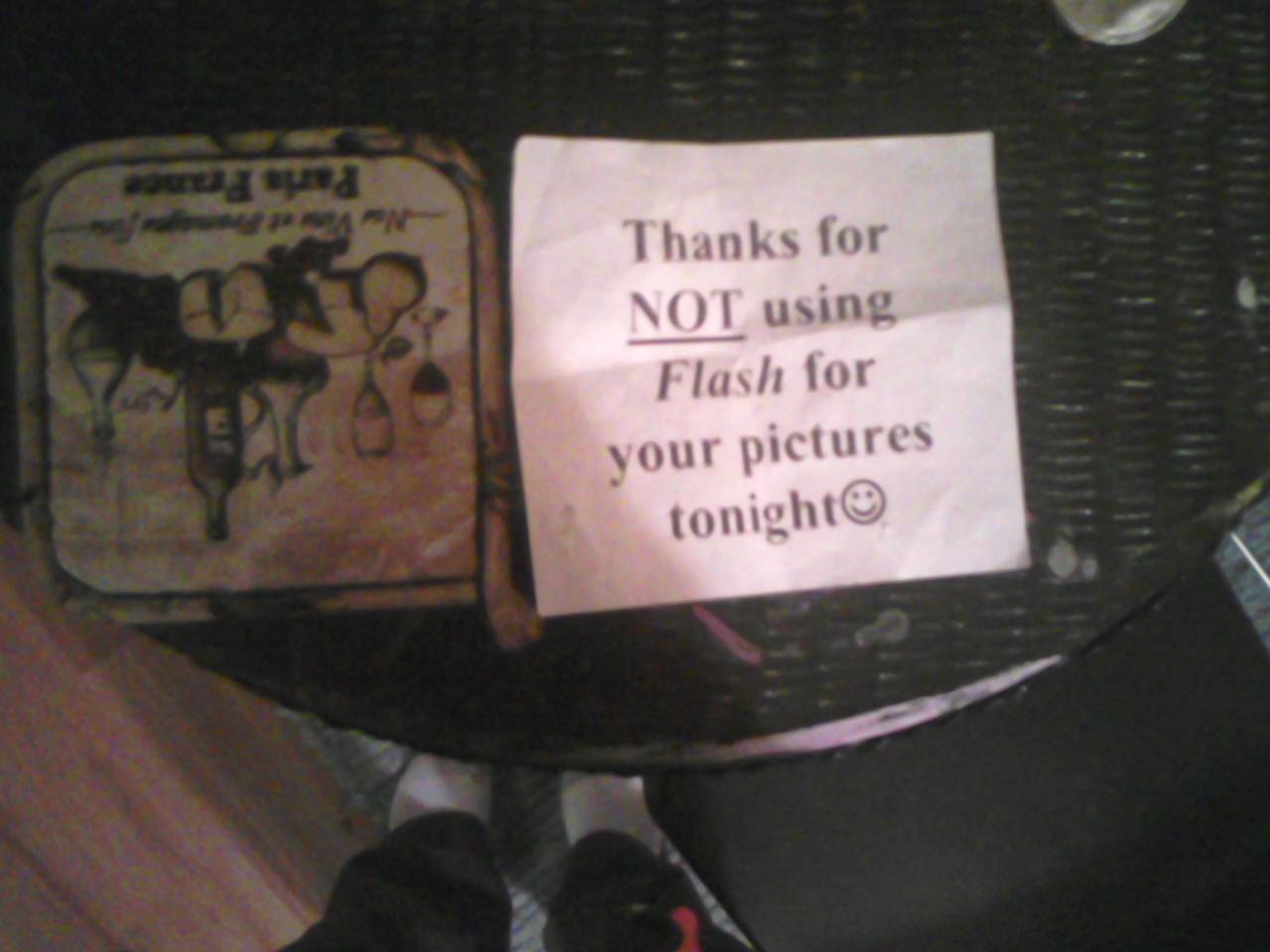
Third, a picture is worth a billion trillion words. Here is the sign that an organization with a lot of crossover with the people who put on PLX thinks is acceptable acquiescence:

Please note the potholder. It's there for perspective. Cuz not only is it worded as circuituitously as possible, it's also the size of a damn potholder.

The sign I printed out, which this other organization (that I suspect "anonymous lindy hopper" is deeply involved in) keeps losing, looks like this:


It says "NO FLASH PHOTOGRAPHY" above and "Thank you for your cooperation" below. It takes up a whole 8.5x11 sheet of paper, which is the minimum to get anyone to look at anything. And it did not take any special skillz or money to make-I did it in about 3 minutes, so neither time nor money are an investment here.

I left a whole lot more bullshit unpointed out, so everyone can play!

ETA: Obviously nothing I am asking for costs anything. Well, maybe kicking Assaulty Camera Guy (Evrim Icoz, for those playing along at home) out does, but so does paying him, & paying people to assault your customers is a really good way to get them to not come back and write a blog post that says that Portland Lindy Society paid Evrim Icoz to assault me with a strobe light at Portland Lindy Exchange. Other than that, no idea what the purpose of that straw argument is. Ideas, neurodivergents?

Monday, January 23, 2012

Conflicted Emotions.

This is what I wrote down trying to process my feelings & thoughts after learning of my mother's death. It's all very jumbly & confusing

So this weekend my mother died, & I'm not sure how I feel or how I'm supposed to feel or really anything. Those of you who know me know that I've not had a relationship with my mom for years, but that doesn't prevent the emotional confusion.

The last thing my mother said to me was "get a real job or die on the street." I was extremely, obviously ill at the time, & that was what she had to say. She had spent the previous several years hurting my physically-I have dents in my skull that I was not born with-and verbally abusing me and justifying her husband's abuse of me. So, if that is my mother, if that is who she is, then how I feel right now is probably appropriate and normal. Mourning one's abuser and tormentor isn't something that is reasonable to expect of anyone. Numbness, if not outright relief, is a reasonable thing to expect.

But my mother wasn't always like that. When I was young, she fought for my intelligence and capabilities to be recognized. When I was being tormented at school by teachers and students alike, she logged many many hours talking to teachers and parents of other kids in my classes. I've been having roughly identical "WHY IS EVERYTHING SO DAMN DIFFICULT?!?!?" meltdowns since I was about seven years old. When I was little she'd squish me tight, stroke my hair, & say "I don't know, punkin. I just don't know." She didn't understand me by any stretch of the imagination, but the mom I had when I was little sure tried. She made mistakes, as do all parents, some of them pretty huge, as with all parents, but the mom I had when I was little was doing everything in her power to do what was best for me.

And that's what makes this so complex & difficult. The mother of Little K was a woman worth mourning. The mother of Adult K was scary & upredictable & abusive, and not ever dealing with her again is a relief. But I had it in my head that Little K's mom could be somehow revived.

That's probably not the case though. Little K's mom died a long time ago, I think, even though her body never went anywhere. I think I knew that and did my mourning and mental burying a long time ago. The scary person occupying her body is not the mother I could once depend on to always be on my side, even when she didn't understand why that was my side.

So being numb is probably ok. I think I came to terms with my mother's death years ago and just hadn't thought of it that way. Feeling guilty about being numb, probably also ok, but not necessary. Or something. I don't know.

Saturday, January 21, 2012

Guest Post-To The Parents Of Newly Diagnosed Kids

A friend of mine, pseudonym of Gen Eric, wrote this. It's great & wholly unedited, except for some HTML fixin'. Enjoy.

Your child is probably between the ages of two and five, possibly older (even much older) and possibly (though unlikely) younger. Your child was probably developing just like any typical child until slowly, and almost without explanation, things seemed to take an unusual turn. Maybe they lost speech, or eye contact, or just started doing “unusual” things like stacking or lining objects. Frantically you run for a medical professional, who looks your child over, does some tests, takes you into a room, and tells you a word you’ve been conditioned since childhood to fear.

Autism. (DUNN DUNN DUNN, DUNNNNNNNNNNNNNNNNNN!!!!!!!!!!!!!!!)

Your heart sinks. Your dreams of college graduation and grandchildren seemingly fly out the window. This professional probably fills your head with images of someone who will never relate to the world, never get a job, never live independently. Running to the Internet, all you seem to find is tales of financial ruin and broken families. You sink into a deep depression and desperation. How can this child, who was so normal only a month ago, suddenly “vanish” into this “void?” Obviously they just got sick, or trapped, and it’s your job to rescue them.

Now that all that unpleasant business is out of the way, I only have two things to say to you: welcome, and don’t be afraid.

Welcome to a fascinating new adventure with your child. Welcome to learning more about yourself than you ever thought possible. Welcome to a true autistic community that is ready to accept you with open arms.

Don’t be afraid, because autism is nothing to be afraid of. The media has been filling your mind with “autiephobia” since before you can remember. The autism industry is no better, and is actually much worse. They need to keep you afraid so you’ll buy every pill, potion, and behavioral “treatment” they offer, in classic medicine-show style. They need to keep you afraid so you’ll keep donating, keep walking to bring in donations; if you don’t, where will they get their exorbitant salaries? If you give in to the fear, it will consume you and your child. If you stand up to the fear, it will eventually back down.

I call this an adventure, but remember, it’s not an adventure that ends with a normal or “recovered” child. Your child could regain speech, get mainstreamed, succeed in college and work, marry, and have children, or none of those things, or any combination thereof; but no matter what they’ll still be autistic, every bit as autistic as they were the day they were diagnosed. There is no such thing as a “cure,” and there is no normal child who got sick or trapped in some autistic shell. The only thing the “cure” industry does is to give you a stone to make your soup, then sit back and declare victory when your child naturally develops.

It’s true that with behavioral “therapy” (animal training), your child may learn to look, and act, normal, but they won’t be. All they’ll be is an autistic person who is afraid, or ashamed, to be an autistic person, and loaded with a host of mental baggage. They may even harbor a deep resentment towards you, which is the last thing any parent could want. Your child is unique, and will always experience the world as an autistic person, and that’s not a bad thing.

The autism industry tries to paint neurodiversity and autistic self-advocacy as some kind of anti-parent cabal of “high functioning” “aspies,” who instinctively hate you for trying to cure your horribly ill child. The truth is that neurodiversity activists are as unique as autistic people themselves. Most of us are autistic, but not all. Some of us have an autistic child or other family member, some are romantically involved with an autistic person, and some of us got into neurodiversity through an autistic friend. Some of us are labeled “high functioning,” some of us are labeled “low functioning,” and some of us have been cycled through labels like some people cycle through hairstyles. We also have something meaningful and wonderful to offer you.

What neurodiversity offers you as a parent is the hope for a world where your child will be accepted on their own terms. Neurodiversity offers a chance to fight for what your child really needs, access and respect, as an autistic person. The neurodiversity movement values your child for their individual strengths and offers understanding for individual weaknesses. Believe it or not, we’re the ones really fighting for your child. We welcome NT allies and we hope you’ll join us in our fight.

We’re vehemently anti-cure (no autism, no me), but we’re not anti-progress. We know that every autistic person will develop differently, but we all develop. None of us are the same person at thirty that we were at five. Your child won’t be the same person at thirty as they are at five. And why would we, or they, be? Are you?

So welcome, I hope, to the neurodiversity community. I hope reading this has helped you calm your fears and prepare for your upcoming adventure.

Thursday, January 12, 2012

Why I am not going to Portland Lindy Exchange

I swing dance (lindy hop). I'm actually a pretty good dancer, if I listen to other people. And I enjoy dancing. So why the hell am I refusing to go to the biggest dance event in my own city?

Because they fucking refuse to even pretend to follow the ADA, that's why. Last year's was the absolute worst weekend of my life--and I have been abused & mistreated & sick in ways that mean I have had some fucking bad weekends, the kind of fucking bad weekends that most people cannot imagine. Bad enough that I am willing to name names and if people's feelings are hurt, they can climb a rope and let go, because 'hurt feelings' are not remotely in the same range.

I refuse to spend that kind of money to be in that kind of danger.

Last year, the Portland Lindy Society's lawyer called me & we had some discussions. She isn't an ADA lawyer, but since she had been to law school she knew what the ADA is and how to read a law (for those who don't know, the ADA is pretty fucking simple to understand anyway). The agreement was that they'd say no flash photography & that they'd have an event photographer who was supposed to be competent enough to not strobe all over & that he'd avoid me. I'm not exactly hard to pick out of a crowd, either; I wear blue glasses-NOT COMMON.

Let me tell you now about Portland Lindy Society's photographer. His name is Evrim Icoz. He is a sack of shit who should never work again. Ever. Hence the name dropping

This guy who knew damn well he was supposed to not use multiflash & was supposed to avoid the petite brunette in the blue glasses & Chun Li buns was always using multiflash within 8 feet of me at a rapid fire pace-not the exact opposite of what Ivy, the lawyer, promised at allllll. So, not knowing this man is an abusive sack of shit, I ask him to not flash in my vicinity, because it's like being stuck in a godsdamned strobelight and that's not acceptable, nor is it within the agreement Portland Lindy Society made with me. And he flashes his flash directly in my face because that's obviously what a professional does in this situation. You don't say "my bad", you don't go photograph somewhere else, you flash a strobe light right in the face of someone who has photosensitive epilepsy that you already knew about! Ethics & professional code say so!

So this guy, Evrim Icoz (seriously, I hope search engines grab this shit because it is not acceptable), he starts yelling at me. I'm kind of already about to seize, it is going to happen, & he follows me into the entryway while I'm looking for someone who has some power-a PLS person, the lawyer, someone. This guy is yelling at me that he doesn't know what the hell is wrong with me, I am a crazy bitch, he hopes I die in hell. You already know what's wrong with me, you sack of crap, and that is why you are supposed to change your behavior. Bet you feel like a big man now, yelling at a disabled woman to die in hell. Oh yeah. Such professional behavior.

If PLS were decent people, they'd have told Evrim he had to leave. Are they decent people? No. No they are not.

On the advice of their lawyer they gave my money back & 'allowed' me to stay. It's the least you can do when the event photographer sends you into a meltdown and a 5 seizure cluster, right? Please please please please don't sue us, Miss K. Here's your money! Keep your wristband! Just oh god oh god don't go to the media! I know our photographer is an abusive dangerous man, but please please please stay we'll be better!

Yeah. So fucking much better. Ask me about the next night!

The dance the next night was extremely crowded. Of course it was-it's a big dance event where the people who think they're hot shit from other dance places come to dance with the people who think they're hot shit from other other dance places, and we mere mortals if they don't realize we're mere mortals. Ok, that's unfair, some people from other places are delightful. Just not the ones who think they're Eris's gift to dancing. Anyway, not the point.

This Evrim guy is there again, strobing again! The lawyer and the powers that are at PLS assured me it was taken care of. They're liars. The guy is, again, suspiciously close to me with his deadly weapon at all times. Then he happens to be close to one of my friends, who ended up stuck with my seizure cluster (poor guy, stuck with all the seizure clusters that Portland dance people cause by refusing to make the simple ADA adjustment of banning flash photography. I'm whiny after a seizure & not exactly cooperative). Evrim decided this was a good time to, in the name of professionalism, shove my friend & try to start a physical fight. Not just any physical fight, but one in the middle of an extremely crowded dance floor. The bit where he told my friend to die in hell was an extra bit of acting like an adult paid to be there, in my opinion.

Then my friend tries, again, to talk to someone from PLS. I'm well on my way back to seizureville-the total for the weekend was over 30 as I recall-and this is unacceptable. The woman who he finds first (maybe not first. Maybe who he was told to talk to. I don't know. Most of my memories of that weekend are snapshot memories & waking up somewhere with a hangover-except I don't drink) decides that the appropriate reaction to having the professionalism of their photographer challenged is to start hyperventilating and saying she was convinced friend was going to hit her. That falls in the category of things I can never ever see happening. Anyway.

After this woman gets herself together, complete with guilt trip & me taking a few trips to Planet Not There, she does...nothing! She says she'll talk to him! She doesn't! He's paid to be there, you see! They can't do anything about him trying to start a physical fight on the dance floor or attacking a paying customer! Because she can't! Because not killing me isn't anywhere near as important as some fucking photographs!

We went and talked to the lawyer that night because of the profound unacceptability of this guy Evrim's actions and the complete denial of responsibility from Desha, the PLS representative. I have no recollection of this meeting; I was so far into seizureland that I just don't know. I seem to recall that the lawyer will no longer work with PLS but that may be faulty memory.

So I will not be spending any money on Portland Lindy Exchange, or indeed Portland Lindy Society, events again. They owe me one hell of an apology, as they have known for nearly a year. Assaulting someone with epilepsy with a strobing flash is not ok. Shoving someone on the dance floor is not ok. Verbally attacking people is not ok. Choosing to support the so called professional who does this rather than your paying customers-extremely not ok, unprofessional, and a great way to lose customers.

I will not pay money ever again to have my physical and emotional well-being put in danger. Portland Lindy Society willfully contributed to physical and emotional abuse of a loyal customer and that is not just unacceptable, it is illegal. I am disabled, I am not less, and I deserve better.

Background for the rageification: I've kind of had it with people being all "but ensuring accessibility is soooo haaaaaaaaaaard" when all they have to do is post a sign or turn their light to solid or whatever. Fuck you. I have to do this shit all day, every day, & so if you think me asking you to enforce a "no flash photography" rule for 3 hours is such a burden, go get a whaaaaamburger & cheese cries, because I do this every damn day & I don't get sympathy for it, I get abuse for daring to stand up for my rights.

Saturday, January 7, 2012

More Toxic Lessons Learned

A common theme of my youth was that I was worth less if I didn't have friends and a social life. Another prominent idea was that no matter what, if people didn't like me, it was my fault and my responsibility to change that. Having an opinion on what I'd like or not like to do or expressing discomfort with someone or something was being "bossy" or "too demanding" or "high maintenance", and none of these things are ok to be.

So I was this kid who was told that social approval defined my worth, and who was told that if I in any way challenged what my social peers decided to do I was screwing that up. Basically the message I got, both directly and indirectly, was that people were doing me a favor by tolerating my presence at all, so I should shut the hell up and be grateful and go along with whatever.

Ask me if I think my worth is determined by social approval and I'll say hell no, because it isn't and never was. If people don't like me is it my fault? Well, maybe, but that's their loss now isn't it?

But some of that toxic stuff internalized. I know in my head that people aren't doing me a favor hanging out with me, but that doesn't mean I really know it. I rarely feel comfortable asking for a plan change, and while I call out ableism frequently, I don't feel allowed to be as intense about it as I should if it's consistent and consistently minimized. If someone's behavior is unacceptable to me, I'm more likely to remove myself then request or demand a change, even if I know and like everyone else there. They may be my friends, but I "know" that I'm not allowed to be uncomfortable and ask to have that discomfort remedied, because I "know" they only put up with me as charity or something.

That is some messed up toxic shit, and I learned it from people who supposedly wanted the best for me. I'm an adult and I've been demanding to be seen as a whole, worthwhile, unbroken human being for nearly half my life, yet I still can't totally shake this crap. I know it's bullshit. I know I have the same right to express my needs in a social setting as everyone else.

But that knowing doesn't suck the poison out, now does it?

Thursday, October 27, 2011

Advocacy: Everyone Can Do It.

This story happened a long, long time ago, almost 10 years now. It's still exactly what I think of when people tell me about their kid who will "never" self advocate.

I worked for a few years with a boy who we will call C. C was about 9 when I met him. He was nonverbal, really hated typing on the computer, knew a few signs, and had a PECS book. He had experienced many years of ABA therapy, which is very much therapist directed, and he was growing increasingly frustrated with how things in his life were going. His frustration was pretty clear-he was angry a lot of the time and he was lashing out physically when a lot of demands (or unpleasant demands) were made. His PECS book often didn't have what he wanted to communicate in it, so that added further to his communication challenges. What he was left with was behavior as communication.

I'm pretty sure C's parents weren't exactly looking for self-advocacy teaching, at least not what I do. They had the whole "autism as tragedy" thing going on, were into quackery, kind of seemed to resent C for existing (ok, so very much resented C for existing) and wanted compliance and normalcy, not what I was offering. But C and I hit it off right away & I wasn't completely horrified by his expression of his anger. I avoided getting hit, obviously, but I wasn't going to restrain him or, nearly as bad, throw more and more demands in his face when he was upset. That's silly. It does not work. Typicality is not a realistic goal, but being able to express wants and needs is, and it was quite likely that C could learn a more expedient way to make his wishes known.

When I started working with C, I had a rule for his ABA therapists and parents: if C made clear a want or a need, he gets it. If he indicates that he doesn't want to do same with same or whatever, he doesn't do same with same. If he indicates that he is not ready to leave an activity, he doesn't have to leave yet. He needed to learn that he has some agency after so many years of following other people's agendas.

What's the first thing little kids tend to learn to take power over their lives in small ways? The word "no", right? I wanted C to learn that he could ask for things and get them, and that he could say he didn't want to do things and get that. A lot of our time was spent playing and him indicating he wanted or didn't want things, and me putting into words "No, don't take your block? Alright!" or whatever when he indicated in any way that he didn't like what I was about to do or did like or want something. Showing him that adults do take his wishes into account.

Then I took C swimming one day. This was something his ABA therapists didn't like to do very much because apparently it's a battle to get him out of the pool, he liked swimming in the deep end even though he wasn't an awesome swimmer & keeping him in the shallow end could be meltdown inducing-he could swim, but needed an adult right there. Not a battle I wanted to fight, but I'm not a fan of the Adult As God paradigm. I liked swimming and I liked C, so it was a good time.

We did some laps, we (well, C) splashed around in the shallow end, and 15 minutes before we actually had to leave I asked C if he was ready to get out.

"NO!"

Clear as day, emphatic, and with feeling.

Yeah, we didn't get out of the pool for another 10 minutes. C indicated no, he was enjoying himself, he did not want to leave. And he did it in a way that no one could deny-no is an important concept in making one's needs known, and everyone knows what it means.

He used the word NO a whole lot-they made him do a lot of inane things (touch nose? Really???) and he didn't want to. I don't blame him; touch nose is not exactly a meaningful activity. He started indicating preferred activities & even started helping make a schedule of stuff he'd do during his sessions (or what toys we'd play with & such...interactive toys for demonstrating "I don't want to" or "don't do that" are pretty great).

Then he stopped & started biting again. Being bitten hurts. Biting wasn't getting him what he wanted. "What. Did. You. DO?" was my question to the ABA people.

"Oh, he didn't want to do (some meaningless task) and I hand over handed it."

"...what the hell is wrong with you?" (insert about 15 minutes of full volume yelling about how it was his body and he had a right to not be touched and he had a right to determine his activities, and she owed him one hell of an apology, and he was going to get that apology. Where C could hear it. And where C's parents could hear it, because they were in the same county).

She thought I was kidding. I wasn't. She quit shortly after-apparently apologizing to a just turned 10 year old was beneath her, or to an autistic kid, or being told to by an autistic adult, I dunno.

And C started saying NO! again. Then we started fixing his book & set up a dynavox, but that's a whole other story....

Monday, October 24, 2011

Just Don't Use That Word.

Two stories, both from this week, both illustrating how far we need to go in terms of the general public acknowledging that developmentally disabled adults out in public are, like, a thing:

Friday I went rock climbing. The facility has started charging an obscene amount for equipment rental, so my friend and I hit the discount outdoor supply (yeah, this city is so awesome that we have one of those). The guys in the climbing section were awesome-they even found a harness to fit me (I'm in a weird 'tweener size range). They were great, especially given that it was towards closing time on Friday and they were suddenly confronted with several people who all had drastically different needs.

So anyway, even though I was dropping a substantial chunk of change, I was pretty pleased. Then we go to check out & the chick at the register calls her machine r*tarded. Really? Really?! I could feel my climbing buddy wince from 10 feet away.

Don't use that word. It's ableist and unacceptable and hurtful. Oh! but it doesn't mean that! she says. It means slowed down and the meaning has changed and she grew up with foster kids and "worked with those people" and endless stream of justification.

Yeah, no, lady. And developmentally disabled people may be dropping $120 in your store right now and may be very much reconsidering that choice. The correct protocol is to apologize and STFU. And if you call me hun again I am going to slap your face off. The only thing that kept me from walking out was the knowledge that the shoes alone usually run around $200.

Then there was Sunday. As I've blogged about before, I swing dance. I have made some very good friends dancing, and it partially fills a gymnastics-shaped hole in my life. Anyway...

This very nice guy who's been dancing forever brought his nephew or cousin or something (younger male relative, in his earlyish 20s I'd guess). The kid kind of rubs me the wrong way, but whatever, right? There are lots of decent people with whom I just don't mesh, personality-wise. So this dude comes out to Denny's with us after the dance. We played this ridiculous game, Quelf the Card Game-as opposed to Quelf the board game-which involves doing silly, silly things.

Dudeguy pulls a card and says "I won't do this. It's r*t*rd*d." Don't say that word. It's bigoted. "Can I say 't*rd*d?" Well, not if you don't want me to think you're a bigot. Don't spew that hate in front of me.

Insert his not knowing what ableism is here (it's like sexism or racism, except against people with disabilities!). Insert "but I didn't know anyone here is disabled" as a justification here (because it's totes OK if no one is there to be offended, amirite?). Yeah, dude, I'm autistileptic. Nope, your claim of "borderline autism" doesn't impress me-you're still 100% ableist asshat and there's nothing that will justify that.

The guy asked if I'd be offended if he carved "fuck your god" into his arm. Non sequitur much? At this point other people are telling him to just stop, and one friend pointed out that I'm an atheist, if he was going for shock value with that one. I really don't care, it's his arm, though I do wonder what the purpose of doing that would be.

Then we get more word vomit of the R word & "well I don't know what other word to use!" Um. Bullshit. There are lots of other words and after you call me an fing r I have no reason to educate you-you are not worth my time after that. The guy just won't stop with the offensive and my friend tells him he is no longer welcome at our table-I was ready to leave at that point, but apparently I wasn't the one being an asshat?

This guy then goes around with the card that he insists playing would make him look like...well, that word (as though there is no worse fate than the late night crowd at Denny's wondering about you!) and he asks the waiter and all the stoners and other assorted riffraff that frequent Denny's at 1 AM for an adjective that describes the action on the card (please note that I absolutely without reservation consider my group part of that riffraff as well).

He. Asked. The. Waiter. To. Justify. His. Ableist. Hate. Speech.

The waiter was having none of it, fortunately, so this guy just stood at the side of our table for an hour while everyone ignored him. And on his way out he made sure to be vaguely threatening while using the same word about 10 times in one sentence.

But still. Hate speech. He fought that hard for his "right" to use hate speech.

My friends are awesome and wonderful, I must point out. There are so many similar situations where being not-ok with that word is somehow embarrassing or something, and they were pretty solidly "just stop, dude", which is just a symptom of their amazingness.

But this isn't the kind of thing that should happen at all.

In both these situations, people felt they were entitled to use words that the communities they are used against have explicitly said they disapprove of. And then when I, a member of said group, said "that isn't cool" (and according to witnesses, in the kind of way that isn't even offensive, since argument from tone is so damn popular), they felt they had a right to argue their right to use That Word, even though they'd never dream of using similar slurs, because they somehow have the right.

No.

It is not ok to use my people-yep, we're all stuck with each other-as your insult. And you sure as hell have no right to try to argue that because you know a disabled person or don't know that someone is a disabled person it's ok. Your bullshit, it is not flying here.

Saturday, October 22, 2011

For the billionth time: I DON'T HATE PARENTS

Well, not as a general rule. I make exceptions obviously, but someone kind of has to earn my ire.

Some absolutely wonderful people I know are parents (obviously. I work with kids). Some of them are even parents of autistic kids. Some parents of autistic kids have been nothing but lovely to me. I count some of these people as friends, even-a much more exclusive group than "people who are pretty alright".

If you are a parent & feeling like I hate you because I call you on something that's a problem-NT centering, for example, or calling yourself the autistic community when you aren't autistic, or for accidental use of silencing tactics or whatever-that does not mean I hate you! If I hate you, I'll probably say so, in so many words.

It is not an attack on all parents when I speak the ugly truth that many, many parents are horrible. Don't tell me that doesn't happen. It does. Been there, done that, paid the therapy bills. Don't tell me that parents don't center themselves in discussions on disability. A lot do. Many probably don't mean to. The ones who persist in doing so are irritating. That doesn't mean I hate them, unless they're really egregiously obnoxious about it.

I am not demonizing parents as a group pretty much ever. Those of you who think so really need to get over yourselves. If you feel 'demonized' by someone with a disability calling out problematic behavior, then maybe you need to look at yourself and why you feel hurt, especially if you insist you aren't Like That. If you are so deeply hurt by hearing about specific things that specific shitty parents have done, dig deep inside yourself and figure out why that is. Is it a knee-jerk feel-offended-because-someone-didn't-glorify-parents-of-disabled-kids? That's a personal problem that you may need to work on. Is it an I-feel-bad-because-I-empathize-with-these-shitheads? That's a different kind of personal problem. But it isn't me demonizing parents (I keep using that word because it keeps getting thrown around and I don't really know what the users are using it to mean, except "making out to be a demon") when I give specific examples of parenting choices that are shitawful.

But I don't hate parents! I hate certain things some parents do! I hate parents who are horrible people. That isn't unreasonable! I hate when parents tell me I need to shut up because of whatever stupid reasons! Also not unreasonable. And I think it's fair that I hate the dad who decided that stabbing an autistic teenager in the arm because of...whatever reason he gave, something about his wife and crying...was a good idea. Don't tell me that's unreasonable either!

So, if you think I hate you because you engage in any of those things, I don't, probably. But I sure think they're shitty things to do. If you want to know if I hate you, specifically, you can ask instead of assuming.

But I probably don't. I just won't hide what I think to make people less uncomfortable.

Friday, October 14, 2011

"Just be NIIIICE": Argument from tone is BS

Let's say you're talking about social justice with someone of an oppressed class (and, for sake of argument, in that particular arena you have privilege). They're saying things you don't want to hear, uncomfortable things that hurt your feelings or make you feel bad. And let's say this person is saying what they mean, rather than sugarcoating it or apologizing.

You turn to the guaranteed conversation stopper: Argument from Tone. "You don't have to say it that way!"

Yes. Yes I do.

It's incredibly arrogant to dictate to someone how they say say things. Most of what gets brought up in these sort of discussions is difficult, it's real and it is raw. And we get told by privileged people all the time that what we have to say does not count because we are not them.

In autism discussions, this already huge problem is worse. Not only is it privilege abuse, but to tell people who are often neurologically incapable of tact and sugar coating that they have to say something 'nicely' or you won't listen to them, that is why it's so obvious that many allistic people want disabled children to talk and disabled adults to shut up.

It is utter ableist crap to say "talk like an allistic, and then we might listen to you." See, we can't talk like allistics. We have a disability that involves social and language differences! Can no one see the problem with demanding that people who tend to have language problems and social differences carefully phrase their language (which can be a battle to put together in the first place) with feelings in mind more than content?

Tone doesn't change what people are saying or why they are saying it. Those extra words, that padding, isn't going to change truth, it's just going to make privileged people feel less guilty. It isn't always about the comfort of privileged people, and it's never about feelings.

If someone is engaging with you about these issues, they probably think you have potential. Then if you pull argument from tone (by the way, it only seems to run one way. If I tell you that what you do is hurtful, no one gives 2 shits), well, there's more of our time wasted. And if you are going to insist it's my responsibility to educate you about autistic culture, don't fucking dare bringing my 'tone' into it.

In fact, just leave tone out of it altogether. Listen for content, not warm fuzzies.

Monday, October 3, 2011

Some things shift. Some don't.

This is coming from my personal experience writing for TPGA's dialogue series. This is extraordinarily, probably obnoxiously, me-centering rather than autistic community centering. It's not taking posts about the dialogues on other blogs into account even a little. Those other reflections may come later. They may not.


The post I wrote for TPGA is easily the most emotionally taxing thing I have ever written. There are a lot of uncomfortable associations with what I wrote about, and with the stories I decided to not tell yet as well.

I wrote that post with the full expectation that I'd be yelled at, accused of being unempathetic, have my words or meaning misinterpreted and misrepresented, told that I was "lucky" for whyever (because I could get into a Y? I don't know). That's my default assumption when I write, especially when I write for a mostly allistic audience, and even more especially when I am sharing uncomfortable truths. That's frequently what happens-I get yelled at a lot.

Mostly, my self-protective cynicism wasn't necessary, at least not in regards to my post and reactions to it. This is kind of overwhelming really-I'm not totally sure how to handle people being so nice to me. Don't stop or anything; it's a wonderful kind of unsettling to have people say they've got my back. I just don't really know how to deal with it.

A number of lovely people are encouraging a bit of a shift in my cynicism & knee-jerk wariness of autism community people who aren't autistic community people. It's a small shift for now, but what has to be a few hundred people didn't yell at me. I wrote something uncomfortable and difficult and no one yelled at me. This shouldn't be a big thing, but it is. A touch of the tarnish on humanity's reputation with me was wiped away, just a little.

But don't think for a second this means that I am going to change what I write about or how I write it. I know that I say a lot of difficult, uncomfortable things. I know the frustration from being an autistic in an allistic land and the frustration from living some truly hellish times shows. It's still going to. People are going to find things uncomfortable, but you know what?

It needs saying. Discomfort leads to growth. And barring specific triggers (which I do try to put warnings for), you can probably handle it. Many autistic people have dealt with similar things and said similar things to what I have experienced and what I have said. They know it is the way of things, for better or (usually) worse. Allistic people? You need to-yes, need to-know not just the "heartwarming" or "inspiring" or the nonthreateningly insightful or the sanitized autibiography stuff. You need to know the awful, uncomfortable things too. Those things need to be acknowledged to be abolished.

You acknowledged the ugly side of my truths, allistic allies and potential allies. You acknowledged that they're both ugly and truth. I make you uncomfortable not to be mean, but to create a more beautiful truth in the future.

Saturday, September 24, 2011

On The Dialogues & The Accompanying TwitterGate

I know, the disclaimer is getting old. Oh, also, please read to the end. I'm really trying to explain where I am coming from & provide ample context, not to attack anyone.

If you don't know what the title is referencing, The Thinking Person's Guide to Autism hosted/is still hosting at the time of this posting a series that will hopefully turn into a dialogue between autistic people & parent advocates (and plans are, autistic parent advocates).

And there was this Twitter conversation between Emily, who is an editor of TPGA, and Robert Rummel-Hudson, who was the allistic parent involved.

And then the internet exploded, because how it reads is "do not listen to autistic people, you do not have to."

What Emily was actually saying, in her own words, is posted here on her personal blog.

That doesn't mean, though, that it didn't read to a whole lot of us as "you do not have to listen to those autistic people". That does not mean it wasn't taken as "you do not have to listen to those autistic people" by someone or many someones.

See, that's the default most people take: not listening to autistic people. That's kind of what started this whole thing, isn't it? Not considering disabled people in disability matters? The whole false dichotomy of either parents or disabled people have voices that count?

When you are autistic or otherwise disabled, you know every day that people aren't listening to you, and certainly aren't trying to understand you. They are often coming up with reasons to not have to listen to you. We've been over all this before-silencing tactics, Not Like My Child, Argument from Tone, Parenting Is Hard, etc. It's significant. There aren't enough squares in a Bingo card, and it stops being funny when you get a blackout on 3 different cards in under 5 minutes anyway.

And I expect variants on "I don't have to listen to you! You can tie your shoes/you're a girl/you're a Scorpio/whatever" from a whole lot of people. It's a pattern.

But I don't expect anything that looks like that from people who I respect, people who I considered to be, you know, kind of on my side? And I respect Emily immensely. This post wouldn't be happening if I didn't respect Emily immensely. Based on her blog she has done a lot for her sons that I wish my parents had been willing and able to do for me. None of this is intended as attacky towards Emily.

Reading the Twitter feed, we have no context for what is going through the minds of the people tweeting. Read alongside the thought process post, the conversation makes a lot of sense and isn't particularly offensive. Other people are talking about neutrality issues, but I really don't give a poo about that-I like to assume if an autistic poster was similarly hesitant, someone from TPGA would be supportive of them, too, so that's reasonable to my eyes.

But what we see without that background information? It's kind of like that game kids do? "Open your mouth, close your eyes, in will come a big surprise!" and you're expecting something delicious because it's someone you trust, only instead of something delicious they give you a vinegar soaked cotton ball. That other kid over there may always stick vinegar soaked cotton balls in people's mouths, but this person usually sticks to fine chocolate! What just happened?!

I suspect if it wasn't everywhere that autistic people are to be neither seen nor heard nor understood, no one would have even noticed. I think that's where I was going with this. Unfortunately the dynamics of advocacy being what they are, & the inability to infuse relevant information to interpretation, probably made this whole Twitter thing bigger and more awful than it ever needed to be.

Friday, September 23, 2011

"Dialogue", Disillusionment, Disheartening

The syntax of this post brought to you by Vicodin/Flexeril/the pain that those are supposed to be covering but aren't. If I don't make sense, I'll fix it later. Or not. But this matters too much to just wait until I feel better & have a good communication day.

As I said on twitter, I am frustrated by the exchange on Thinking Person's Guide To Autism. The idea of this exchange, for anyone unfamiliar, was that 2 autistic advocates-Ari Ne'eman and Zoe (who's surname I am not comfortable publishing in case it's not Common Knowledge)-and a parent advocate-Robert Rummel-Hudson-were going to have a conversation and come to some mutual understanding or something. The background of this is that RRH wrote a post about some offensiveness in a movie trailer & that a parent or sibling of a person with targeted offensiveness might be offensive, Zoe wrote a post back that basically said "you're missing someone and here's why that's uncool" and the comments of both posts exploded the internet.

Having been around the autismsphere for kind of a long time, I wasn't sure how this'd go, but I do like to give people the benefit of the doubt; I assume that most people do the best they can and will evaluate things if they're presented with evidence that their way may be wrong. Yeah, I'm kind of an idealist. This contrasts pretty sharply with what I've experienced, but you know one parent of a disabled kid, you know one parent, right? Maybe the ones who are hostile are a vocal minority?


I encourage everyone to go read those posts right now. I'll still be here.

I think Zoe was the epitome of class in both of her posts. I really do. She is doing something very difficult very publicly. She is explaining some very rough concepts, concepts people get defensive about, and she is doing it for an audience that appears to mostly speak NT. Her 2nd letter was very good as well, possibly more difficult to write-what it was a response to was pretty infuriating to read-and clear and consistent. I'm a fan.

Ari is Ari. He covered a lot of the ground Zoe did, but differently, & he brings a lot of background in the kind of advocacy that people see into things. And of course the issue of parent-advocates making assumptions on what people can do because of their point of view (which is a logical fallacy that needs a name if it doesn't have one. Or maybe an internet law: As a conversation between disabled people and parents of disabled children progresses, the likelyhood of the adults involved's abilities being grotesquely exaggerated by a parent is directly proportional to the unpopularity of their opinion with said parents). A lot of the bigger picture issues were brought up, and, like Zoe, Ari was very classy in the presentation of his points.

So to recap what I've talked about so far:

Two autistic adults are posting on a blog that appears to be mostly parentcentric and secondarily professionalcentric. We're tertiary, right? Those two autistic adults are having an extension of a conversation in which there were many swings and misses and disconnects about whose voice should be heard about disability.

Said autistic adults are being a level of tactful that is neurologically impossible for some of us (and I applaud them for it). They are actually reading what is being said to them & appear to be considering other view points. And they are doing this knowing that there is this big power imbalance here, because there always is in this sort of thing-nondisabled privilege is a very real thing.

And oh my oh my is that privilege on flaming display!

I do not doubt one bit that RRH loves his daughter and that he wants the best for her. I do not doubt that 99% of parents love their children and want what is best for them.

I doubt strongly that RRH listened even a little to anything Zoe said. To paraphrase a comment, his first letter is like someone read several posts on how to shut down advocates and used it as a template. People always ask us what we mean, dismissiveness? Right there. The "Not Like My Child" and "Too High Functioning to Be Listened To"? Right there. Egregious assumptions about what people can do based on their ability to write coherently? Right there. Misunderstanding and misuse of the word privilege? Oh yeah.

It was appalling. It is inappropriate, ALWAYS, to say that someone with a disability isn't disabled enough to have a valid opinion. It is inappropriate, always, to have a "dialogue" without responding to what you are supposedly responding to. The first letter was an essay on why Zoe has no right to advocate! And that's unacceptable.

The second letter was not any better. It may have been worse. I mean, I guess I'm glad that RRH admitted that he thinks it's right that parents have the major voice in advocacy, but not because I agree-because then I know I'm not reading stuff in. Kind of like I appreciate RRH suggesting that disabled people are basically tools for parents to use in their quest to help their children-I have known without a doubt that people think like that. Very few admit it, but there it is in black and white.

We are not tools. We're often accused of using other people as tools, but I see quite the opposite going on here. Advocacy for a child belongs to the parent, but advocacy for the disability community belongs to the disability community. I love allies with all my soul. Anyone who says it's appropriate for allies to have more voice is not my ally.

The comments have been very interesting. I daresay they're more productive than the 'dialogue'. There have been some visitors who already get it. There are some who may never get it. But it looks like in the comment section, actual exchange of ideas is happening.

Twitter has been a nightmare, apparently. I'm not involved in any of the conversations, I would just like to register that based on screenshots I've seen, some people I used to think get it clearly don't. You aren't our ally if you tell people they don't need to try to understand us-especially if you are loudly demanding that we "have to understand" your point of view as a parent.

Overall I find the whole thing very disheartening. There was a genuine attempt at outreach from autistic people. There has been so much smacking down and hypocrisy. The upside is now I have a nice condensed example of exactly what I am talking about when I talk about the dismissal of advocates and abuse of the power differential that parents & professionals engage in whenever we do our thing.

That isn't what I want though. I want more. I wanted to be shown that my defensiveness around parent-advocates is generally unnecessary. I wanted the power differential to be addressed. I wanted an acknowledgement that disabled people are the primary stakeholders in discussions about disability. I wanted to be shown that parent-advocates, like disabled-advocates, are doing the best they can, that they will try to understand, that they can and will listen.

What I got was: Parents want disabled kids to talk and disabled adults to shut up. I hate being right so often.

Wednesday, September 21, 2011

They taught me to not opine.

One of the main goals of autism 'treatment' is passivity. Unfortunately, they succeed at that. A lot.

Those of you who know me are laughing your asses off right now, because "passive" isn't the adjective most people think of when they think of me. But none of you know what it is to be inside my head.

They taught me that having an opinion is wrong. They taught me that wanting a say in what happens is wrong. They taught me that what I think and feel is far less valid than what anyone else thinks, feels, and wants. They taught me that standing my ground is among the worst things I can do.

And I internalized that.

I know, none of you believe me, because if there's anything I am known for it is standing my ground. But keep in mind-I don't give 2 shits what most people think, especially internet people. If I do give 2 shits what someone thinks on the internet, chances are good we are on the same side. We are fighting through the same things. And the stuff I stand my ground on, that I fight for with the whole of my being, it's often a literal matter of life and death-if not my life, someone's, somewhere. And that's worth it.

But what you aren't seeing is the panic and freeze. Every time I am asked for an opinion or a quick decision, even one that doesn't matter-often especially one that doesn't matter-my mind shuts down and starts racing at the same time. Do they actually want my opinion or are they checking to see that I have the right one? What if my opinion is the wrong one? Oh god. It's easier to not have an opinion. I don't have time to figure out the motive of asking and what my opinion is or how to say it in a palatable way. I'm not good at palatable ways, not even for innocuous things.

The way I do advocacy is the only way I can. Brute forcing through the panic, because those beliefs are more important than the very real fear of very real, terrifying consequences. It isn't easy. At all. It's like having to face a rational fear that developed into a phobia every day. But I have to allocate that energy-it's worth it for matters of life and death. It's worth it when other people like me are affected too. It's worth it when the listener doesn't immediately particularly matter to me (sorry. That's how it is) or they can't do anything to me.

But that kind of energy, on everything? I can't do it. The fear is too much.

Fuck yeah, passivity training. Hope you're happy.

Tuesday, September 20, 2011

A disclaimer I am no longer making.

Every time an autistic person says anything, ever, we have to append a big disclaimer. The "This only applies to me and my situation and I know nothing about your autistic child/cousin/sibling/indentured servant so take it with a grain of salt". It possibly has to have a functioning label attached too, depending on how much what we're saying pisses off the listeners.

Yeah. I'm not making that disclaimer anymore.

Obviously I speak from my experience. I have no other experiences from which to speak. I know stuff my peers say, and I can incorporate that into a more detailed response, but that doesn't change that my experience is mine & that is where I am speaking from. Functioning labels are a steaming pile & only useful when allistics want autistic people to shush, so I'm committing myself more fully to abandoning them, too.

No one else is expected to make a disclaimer like that when talking their own lived experience (please correct me if I'm wrong; I've never had to append such a thing to any statement I've made about being a woman or biracial, but that doesn't mean no one has). But the Just My Situation disclaimer is yet another tool used to silence what we say, & I am not going to condone that action by helping bring it to be.

Just like everyone else, I talk from what I know. I speak honestly from what I know. The palatability of what I say has nothing to do with its global applicability, & it is disingenuous to make such a get out of guilt free card for people who may be doing or condoning things that are really awful by making that kind of loophole available.

So, since that whole thing should be understood-that K knows what K knows-I'm not saying it every time I talk anymore. My goal in speaking isn't to make people feel bad about themselves, or good about themselves either. It's to say what I feel needs saying. If it's useful in a way that makes you feel good, fabulous. If it makes you feel bad, look at why it makes you feel bad. Then take what utility you can from that.

The disclaimer get out of guilt free card is now offline.